







But since its launch, the government-backed platform has faced tough competition from established private players Uber, Rapido and Ola. In a written reply to Parliament, Union Minister for Home and Cooperation Amit Shah said that Bharat Taxi is facing early challenges, including competition from existing players.
Launched in February, Bharat Taxi operates under the umbrella of Sahakar Taxi Cooperative Ltd (STCL), registered under the Multi-State Cooperative Societies Act, 2002. Bharat Taxi is the consumer-facing brand of STCL and its core proposition: Drivers are not just service providers but stakeholders.
The Indian Federation of App-Based Transport Workers (IFAT) and the Telangana Gig and Platform Workers Union (TGPWU) have called it a “landmark step towards ending the exploitative commission-based model in ride-hailing services”.
The ride-hailing ecosystem
Data from consulting firm Redseer shows that ride-hailing is mostly a three-player market comprising Rapido, Uber and Ola. In calendar year 2025 (CY25), the pan-India market, in terms of booking value, stood at ₹55,000 crore while 3 billion trips were completed in the same period.
In terms of categories, cabs contributed to 27 per cent of the trips, two-wheelers another 28-30 per cent and autos around 45 per cent.
Saurav Kumar Chachan, associate partner at Redseer, said that in CY25, Delhi NCR accounted for almost 16-18 per cent of the market in terms of trips, which means nearly 500 million trips or one-sixth of the market. However, while cabs make up 27 per cent of the ride-hailing pie across the country, their contribution in the Delhi NCR market is as much as 45 per cent
Recent operational indicators reflect the platform’s growth, with over 517,000 drivers engaged, more than 5 million customers onboarded and nearly 1 million rides facilitated every month across cities. Rapido, Uber and Ola did not share driver numbers.
While these numbers indicate early traction for Bharat Taxi, they also underscore the scale challenge. In comparison, Rapido alone clocked over 30 million rides in NCR in March this year, according to the company. For Uber and Rapido, too, NCR is among the top five markets in the country.
Regarding app downloads on the Google Play Store, Ola, Uber and Rapido each have over 100 million downloads, while Bharat Taxi has just over a million so far.
Chachan feels that since Bharat Taxi is a new platform, it will take time to grow. “At present, in terms of quantum, its market share in Delhi-NCR is in the lower single digits, including all categories.”
He said the market has changed a lot in the last one-to-two years as several players have shifted to the subscription model. “Since Bharat Taxi is also offering a similar model, it will be interesting to see if drivers shift from existing platforms to Bharat Taxi or not. In terms of the subscription amount, overall, drivers will be paying a similar amount to Bharat Taxi as they are paying on other platforms.”
Like most of its competitors, Bharat Taxi has opted for a fixed subscription-led system.
For cab drivers, the daily subscription fee is ₹40, allowing unlimited rides. However, a driver pays only ₹10 if he completes only one ride, ₹5 for two rides, and nothing if he does three or more.
This tiered mechanism appears designed to both reduce entry barriers and incentivise higher ride volumes. It nudges drivers to prioritise the platform while ensuring they are not penalised for low demand days. While the amount is fixed for Bharat Taxi, it keeps fluctuating on other platforms based on demand and supply factors.
Drivers, however, are drawn as much by sentiment as by economics. Almost all the drivers Business Standard spoke to said they joined Bharat Taxi because it’s an “Indian app,” where any commission or fee remains within the domestic ecosystem.
To be sure, this perception is not entirely correct as both Ola and Rapido are home-grown companies, while Uber works in India through its Indian subsidiary.
Still, it’s difficult to beat nationalist sentiments. “If we have to pay, it should go to an Indian platform,” one driver noted, reflecting a broader appeal to national identity that the platform seems to be tapping into.
For now, Bharat Taxi operates in Delhi, Gurugram, Noida, Faridabad, and Ghaziabad in NCR, along with Ahmedabad, Rajkot, Somnath, and Dwarka in Gujarat. However, expansion plans are already underway. It was launched in Mumbai on April 23. Gupta said Bharat Taxi is set to enter Lucknow and Chandigarh by the end of this month and is also eyeing nearby towns such as Panchkula and Mohali. Also planned is further expansion in Uttar Pradesh, including Kanpur.
A few consultancy firms, including Redseer and EY, said there is room for more players but that every new business/app needs to bring something unique that can give it an edge in the market. Bharat Taxi’s USP is just that: One more ride-hailing service to choose from, maybe at a better price point.
Marketing and pricing reset
Bharat Taxi did not begin its journey as the cheapest option. Early users and customers noted that fares were initially higher than competitors’, almost creating a disconnect with its affordable branding. That appears to have been corrected.
As competition intensified, the platform recalibrated its pricing and brought fares broadly in line with those of rivals, Rohit Gupta, vice chairperson of STCL, said.
To support this repositioning, Bharat Taxi has rolled out an aggressive marketing campaign, particularly in NCR. Its branding is visible on autorickshaw hoods, and on milk packets of Amul, a cooperative giant whose leadership is involved with Bharat Taxi.
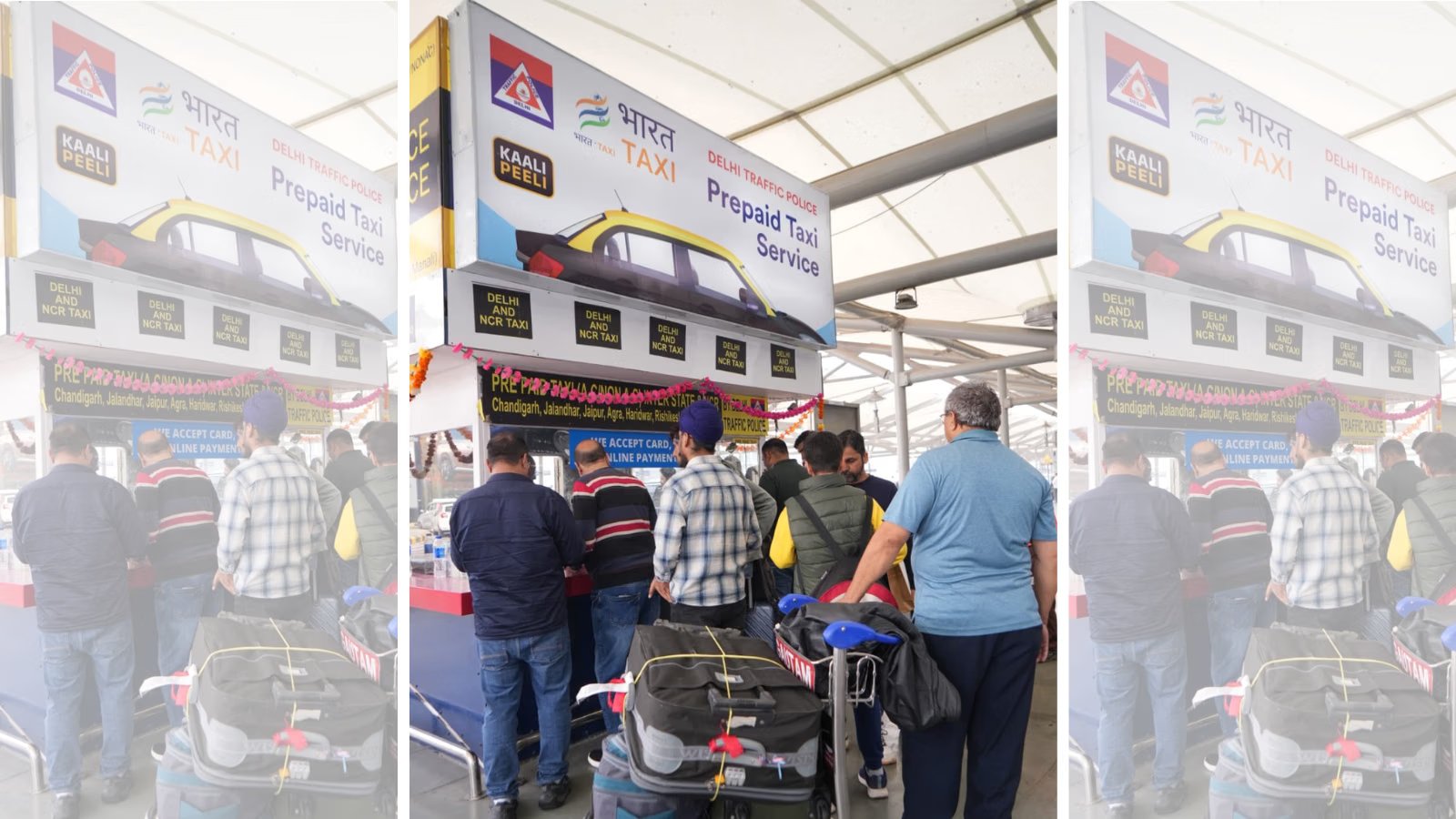
The company has also established physical pickup booths at transport hubs in NCR, including Anand Vihar and New Delhi railway stations, and Indira Gandhi International Airport, as well as at key transit points in Gujarat. The service is also mentioned in public announcements on Delhi Metro as being available at select stations.
One area where the platform stands out is pricing transparency. After each ride, customers receive a detailed breakdown of fares. For instance, on an inter-state trip from ITO in New Delhi to IMS Ghaziabad, the total fare of ₹527 was shown as split into a ₹100 base fare, ₹307.07 distance fare, and ₹120 in toll charges. The driver earned ₹527, the full amount. This detailing allows users to see how much the driver earns and how the fare is structured, something that is often opaque on competing platforms.
Additionally, fare adjustments are dynamic and responsive to actual travel. If a passenger gets down early or walks to a pickup point, the fare is reduced accordingly.
However, driver feedback suggests demand remains a work in progress.
Praveen Kumar, who has been associated with Bharat Taxi since its soft launch, said he logs in daily but receives only three to four rides on the platform. On competitors like Uber and Rapido, he typically completes 12-13 rides in the same timeframe. Most drivers sign on to multiple platforms.
Another driver, Rakesh Singh, agreed that the number of rides is significantly low. This means that, at least at this stage, drivers cannot rely solely on Bharat Taxi for their livelihood.
“The Bharat Taxi app doesn’t ring (“ringing” means an incoming ride request) often, but I keep myself logged in and whenever I get simultaneous rides, I take the Bharat Taxi one,” said Singh. Asked why, he said the app is “Indian” and he needs to do his bit to promote it.
According to one driver, who asked not to be named, a significant portion of rides involve pick-ups or drop-offs at government offices. It may be that since Bharat Taxi is backed by the government, its employees are encouraged to use the platform for their commutes. However, Business Standard could not independently verify this.
Sara Hussain, an early user, said she found the app expensive when it was initially launched and uninstalled it after comparing fares. However, after pricing was adjusted, other customers note that Bharat Taxi is now competitive.
Sarthak Rastogi, another user, highlighted the app’s customer support and responsiveness. After leaving behind his phone in a cab during a Bharat Taxi trip around a week ago, he received immediate assistance after reaching out to the support team. He got the vehicle number, driver’s name, and contact details to establish quick contact and was able to retrieve the phone.
The platform also places significant emphasis on safety. While using the application, users can set emergency contacts at the start of a ride and share trip details directly through the app, eliminating the need for external messaging platforms like WhatsApp.
Users can customise sharing preferences such as sending live locations for all rides at all times, manual sharing, or only night rides (9 PM to 6 AM). In addition, when women search for rides, the app first checks the possibility of a female driver or ‘Auto Didi’.
During rides, prompts such as “I feel safe” and “I need help” appear, alongside a prominently placed SOS button. Post-ride notifications ask users to confirm whether they had a safe journey.
Chachan emphasized that the platform needs to create additional value for customers and drivers. “If new players are coming with a similar offering to existing players, then it will be difficult to take a sizable share of the market. It can help in expanding the market, but taking a sizable pie by doing similar things will be limited.”
The challenges for the Bharat Taxi leadership team are formidable. Given that ride-hailing is a scale-driven business, network effects are critical. Drivers gravitate towards platforms with higher demand, while customers prefer those with shorter waiting times, better pricing, and better availability.
Bharat Taxi’s cooperative model may offer a compelling narrative and potential long-term advantages in driver retention but in the near term, lower ride volumes remain a key constraint.
Business Standard reached out to other players including Ola, Uber, and Rapido for comments on this story, but they did not respond to the email queries.
Privately, however, an executive at a premium ride-hailing company, who did not wish to be identified, said Bharat Taxi’s early traction and government backing could give it a competitive edge. This may intensify competition in the sector and put pressure on existing players to further reduce prices.
Som Kapoor, partner and mobility leader at EY-Parthenon said the Indian market is primarily driven by Rapido and Uber, followed by Ola. He said Bharat Taxi will provide one more option to drivers, especially those across two- and three-wheeler categories, adding that new drivers who are yet to register with any ride-hailing platform might see Bharat Taxi as their gateway to enter the digital ecosystem.
“In my view, it’s a good option for democratisation but for it to be truly successful, they (Bharat Taxi) will have to build a moat around it (i.e. have a proposition which is unique to it). I don’t think they truly have a moat around this. It is one of the four players in the market right now,” Kapoor said.