








Authored by: Kamal Vashisht, Head Policy and Strategic Partnerships, Nirmit Bharat (ONDC and DigiHaat) & Ashish Gupta, Faculty of Management, South Asian University (SAU), New Delhi (An International University established by SAARC Nations)
Lately, India has emerged as a global leader in Digital Public Infrastructure, particularly evidenced by its G20 presidency in 2023 where it championed inclusive digital transformation and established a global DPI repository. The success of its comprehensive DPI, known as India Stack, has been instrumental in driving innovation, expanding markets, and enhancing financial inclusion across the nation. While these advancements highlight the transformative potential of DPI, the rapid scaling and evolving nature of such infrastructure inevitably present a unique set of challenges that require continuous examination and strategic responses.
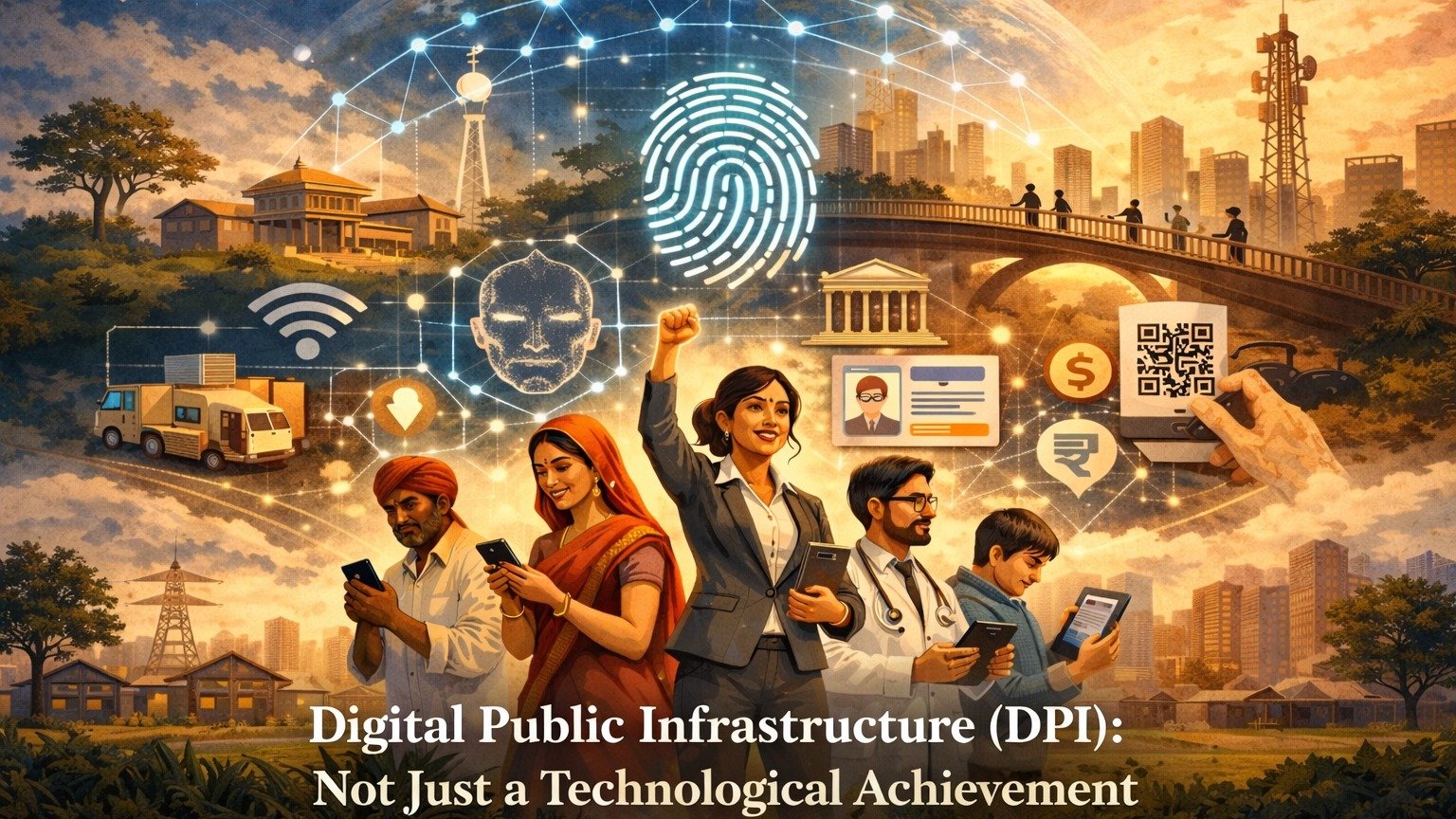
Notably, India’s Digital Public Infrastructure has emerged as a global case study in leveraging technology for widespread socio-economic transformation, far exceeding mere technological advancements. At its core, the Aadhaar digital identification system has achieved staggering penetration, with over 1.2 billion Aadhaar numbers issued by November 2018, covering approximately 92% of the population. This remarkable uptake continued, with over 1.21 billion Aadhaar numbers issued by May 2020, representing nearly 90% of the populace. By March 31, 2022, an astounding 92.8% of India’s 1.4 billion people were enrolled in Aadhaar, solidifying its position as the world’s largest biometric database. Complementing this, the Unified Payments Interface has revolutionized digital transactions. From a modest start in 2016-17, UPI transactions surged to over 45,956.10 million by 2021-22, with transaction values skyrocketing from Rs. 31 million to over Rs. 5 trillion by March 2021. The platform recorded more than 32 billion transactions in 2021, and its share of total digital transactions soared from 17% in 2018-19 to 52% by 2021-2022, demonstrating an extraordinary 115% growth in volume and 121% in value between 2019 and 2022. With projections indicating UPI’s monetary value could cross INR 1 Quadrillion by FY34, these figures underscore the massive scale and rapid adoption of India’s DPI, profoundly contributing to financial inclusion and driving digital economic development across the nation.
However, as India transitions from the rapid deployment of its Digital Public Infrastructure (DPI) to a more mature, scrutinized era in 2026, the “India Stack” faces its most complex trial yet: the integration of the Digital Personal Data Protection (DPDP) Rules. While global eyes are on India as a blueprint for digital sovereignty, internal challenges regarding “Compliance Friction” are rising. Financial and healthcare fiduciaries are currently grappling with the technical nightmare of the “90-Day Rule,” which mandates swift data erasure and correction—a feat difficult for legacy systems built on permanent record-keeping. This legal shift is compounded by a sophisticated new wave of “Synthetic Identity Fraud,” where AI-driven attacks are exploiting biometric gaps to bypass traditional Aadhaar-based security.

Hence, addressing the challenges faced by Digital Public Infrastructure in the Indian context requires a multi-faceted approach that goes beyond mere technological fixes, emphasizing robust governance, ethical design, and inclusive policy-making. Key solution required in this context have been outlined below:
1. Strengthening Governance and Accountability
A primary solution involves ensuring that DPIs are accountable to the public, not just in their impact but also in their conceptualization and design. While principles like open-source, open APIs, interoperability, privacy by design, inclusive design, and universal access are often espoused, their practical enactment has shown shortcomings. Therefore, there is a need to:
· Implement stated principles in practice: Move beyond aspirational principles to ensure they are concretely embedded in the development and deployment of DPIs to prevent harm or unfair outcomes.
· Enhance public accountability: Establish mechanisms that hold DPIs accountable to the public, ensuring that their design and impact align with public good.
2. Enhancing Data Privacy and Security
The rapid digitization necessitates robust measures to protect sensitive information and user data. Solutions include:
· Robust legal and institutional safeguards: Address the mismatch between the pace of data-centric digitization initiatives and the adoption of necessary legal and institutional safeguards. India has been working on data protection bills like the Digital Information Security in Healthcare Act and the Personal Data Protection Bill, which aim to assure data privacy for citizens and establish governance mechanisms.
· Privacy by Design principles: Leverage PbD principles that rely on technological safeguards against abuse and create an enabling regulatory environment for safe data exchange and enforceability. Privacy should be a first-order concern, especially for Digital Public Goods.
· Strengthening cybersecurity: Governments must be cautious and proactive in securing sensitive information against cyberattacks and data breaches. This includes ensuring that security considerations are adequately baked into the design lifecycle of APIs, including those developed locally.
3. Promoting Inclusivity and Digital Literacy
To ensure that the benefits of DPI reach all segments of society, it is crucial to address barriers to effective adoption:
· Address the digital divide: Policies should focus on bridging the gap in access and usage of digital technologies.
· Improve digital literacy: Provide appropriate knowledge and training to citizens to access and use government-launched services. Lack of digital literacy can lead to the exclusion of unfortified groups like the elderly, low-income individuals, and those in poverty from e-governance benefits.
· Avoid coercive adoption strategies: Reliance on coercive digital adoption strategies can be a fault line in achieving fair and equitable digital transformation. Instead, focus on voluntary and well-supported adoption.
4. Fostering Participative Decision-making
Inclusive policy formulation is essential to create DPIs that genuinely serve the public:
· Increase participative decision-making: Address the lack of participative decision-making in the formulation of digital policies. This ensures that diverse voices and needs are considered in the design and implementation of DPIs.
· Prevent opaque API development: While a standardized approach to electronic records and API sharing is beneficial, government control of API design and implementation must avoid becoming opaque and unaccountable to outside stakeholders.
5. Strategic Policy Implementation and Learning
Learning from the evolutionary process of India’s DPI offers valuable lessons for future policy interventions:
· Adopt transformative innovation policy: Address systemic failures in directionality, demand articulation, policy coordination, and reflexivity, as demonstrated by the emergence and evolution of India’s DPI.
· Leverage successful coordination approaches: Continue to utilize the “adroit deployment of social and political skills” and the “hybrid ‘private enterprise within public organization’ coordination approach” that have been successful in fostering sustained support and vision for India’s DPI.
· Embrace a modular, open-systems approach: The “Lego building block approach” allows for repurposing and recombining solutions at a social level, enabling continuous change and innovation. This design approach, focusing on shared building blocks and supporting innovation across the ecosystem, provides powerful lessons for future development.
By focusing on these areas, India can continue to strengthen its DPI, ensuring it remains a tool for inclusive growth and development while mitigating potential risks and challenges.
DISCLAIMER: The views expressed are solely of the author and Adgully.com does not necessarily subscribe to it.