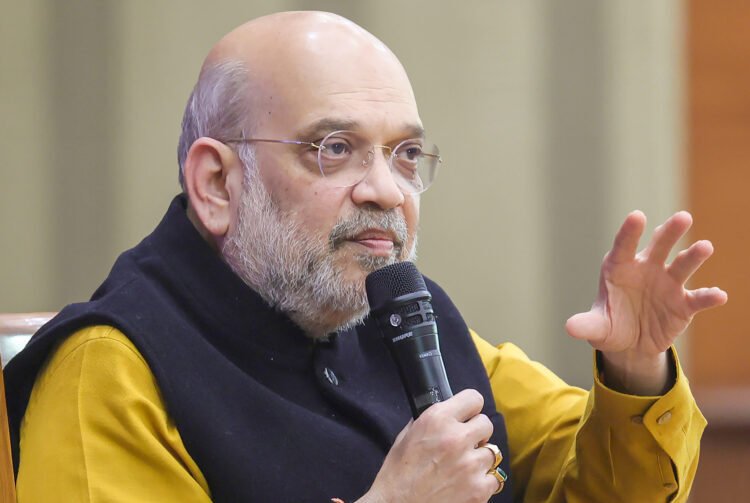






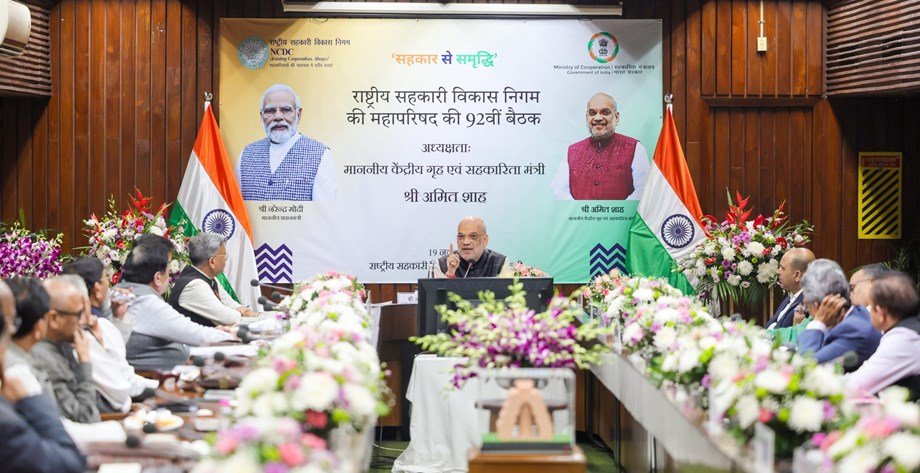
Union Home and Cooperation Minister Shri Amit Shah today delivered a comprehensive address at the 92nd General Council Meeting of the National Cooperative Development Corporation (NCDC) in New Delhi, praising the remarkable transformation of India’s cooperative ecosystem since the creation of the Ministry of Cooperation in 2021.
He emphasised that under the visionary leadership of Prime Minister Narendra Modi, the cooperative movement has entered a new era of structural reform, financial expansion, and grassroots empowerment—positioning cooperation as a central pillar in building an Atmanirbhar Bharat.
Cooperative Sector on a Growth Trajectory Like Never Before
Shri Amit Shah underlined that the NCDC—created to financially empower cooperative societies—has achieved unprecedented growth in the past four years:
-
Total disbursements increased from ₹24,700 crore (2020–21) to a record ₹95,200 crore (2024–25)
-
A compound annual growth rate (CAGR) of over 40%
-
Zero net NPA maintained consistently
-
Highest-ever net profit: ₹807 crore
-
Massive expansion in outreach across rural India
He said these achievements showcase the NCDC’s growing credibility as the backbone of India’s cooperative transformation, catalysing progress in sectors such as:
Cooperation as a Model for a Developed India
Shri Shah reiterated his belief that cooperation is the best model for ensuring equitable rural growth, noting that it enables:
-
Collective entrepreneurship
-
Job creation in villages
-
Fair market access
-
Reduced dependency on middlemen
-
Equitable distribution of profits
He stressed that the government is committed to improving the lives of:
-
Farmers
-
Rural households
-
Fishers and women’s groups
-
Small producers
-
Dairy, livestock, and textile entrepreneurs
Reforming PACS and Strengthening Grassroots Institutions
The Minister highlighted ongoing efforts to convert Primary Agricultural Credit Societies (PACS) into Farmer Producer Organisations (FPOs)—a move that improves farmers’ access to:
He said the shift from individual gain to community benefit reflects the true ethos of the cooperative model.
Driving Organic Farming and Seed Sovereignty
Major national multi-state cooperatives—NCEL, BBSSL, and NCOL—are being empowered to lead India’s shift toward:
-
Organic food production
-
Seed self-reliance
-
Large-scale exports
-
Sustainable agriculture
These efforts align with India’s transition beyond the Green Revolution, toward a climate-resilient agricultural economy.
Blue Economy Boost: Strengthening Fisheries Cooperatives
The NCDC has achieved major milestones in the fisheries sector:
-
1,070 Fisheries FPOs (FFPOs) already established
-
Work underway to strengthen 2,348 FFPOs under PM Matsya Kisan Samriddhi Yojana
-
Financial support for deep-sea trawler purchases in Maharashtra and Gujarat
These steps have:
-
Empowered coastal communities
-
Boosted India’s Blue Economy
-
Supported women-led fisher cooperatives
Sugar and Dairy Sector: Circular Economy and Ethanol Push
Shri Shah stressed the need for a circular economy in sugar and dairy to improve profitability.
Highlights include:
-
₹1,000 crore government grant leveraged into ₹10,005 crore disbursed for cooperative sugar mills
-
Funding supports:
-
Aim: reduce dependency on sugar sales and expand alternative income streams
He noted that ethanol expansion aligns with India’s national goals for energy security and clean mobility.
“Bharat Taxi”: A Cooperative-Based Ride-Hailing Revolution
A new multi-state cooperative society is leading the creation of Bharat Taxi, India’s own cooperative-driven ride-hailing service.
-
Driver enrolment is underway
-
Technological ecosystem in development
-
The model aims to ensure:
-
Fair earnings for drivers
-
No exploitative commissions
-
Rural and small-town integration in app-based services
-
Expanding Cooperative Reach Nationwide
To strengthen last-mile accessibility, NCDC has opened:
This marks an unprecedented expansion into the North-East and Himalayan regions.
₹20,000 Crore Mobilisation Plan for Key Sectors
Following a ₹2,000 crore government grant (July 2025), NCDC is mobilising ₹20,000 crore to provide concessional financing for cooperatives in:
-
Dairy
-
Livestock
-
Fisheries
-
Sugar
-
Textiles
-
Food processing
-
Cold chains
-
Warehousing
-
Women-led cooperatives
Urban cooperative banks are also being strengthened through Sahakar Sarathi, enabling technology-driven services for rural and urban cooperatives.
Youth-Focused “Cooperative Intern” Programme Making Impact
To increase youth involvement in the cooperative movement:
-
The NCDC Cooperative Intern Programme is underway nationwide
-
Selected interns are providing technical and managerial support to cooperatives
-
The initiative aims to create the next generation of cooperative-sector leaders
General Council: Apex Policymaking Body for Cooperative Development
The NCDC General Council comprises 51 members, including:
-
Senior officials from Union Ministries
-
State government representatives
-
NITI Aayog leadership
-
Top cooperative institutions
This Council is responsible for guiding policy direction and financing strategies for:
A New Era for India’s Cooperative Economy
Shri Amit Shah concluded by emphasising that the cooperative sector is no longer confined to traditional activities but is emerging as a powerful engine of:
He affirmed that the government’s vision is to create a cooperative-driven economic model that places India firmly on the path toward a Developed India by 2047.