







Source: PIB
Subject: Government Scheme
Context: The government has updated Parliament on the rapid expansion of the PM-WANI network, with over 3.9 lakh Wi-Fi hotspots deployed across India as of November 2025.
About PM-WANI Scheme:
What it is?
- PM-WANI (Prime Minister’s Wi-Fi Access Network Interface) is a national public Wi-Fi framework enabling affordable, widespread broadband access through decentralized Wi-Fi hotspots operated by small entrepreneurs.
Ministry: Implemented by the Department of Telecommunications (DoT) under the Ministry of Communications.
Launched in: Approved by the Union Cabinet on 9 December 2020.
Aim:
Key Features of PM-WANI:
- No License Required: PM-WANI allows small shops and local businesses to operate Wi-Fi hotspots without needing any licence, fee, or formal registration, making broadband delivery easy and low-cost.
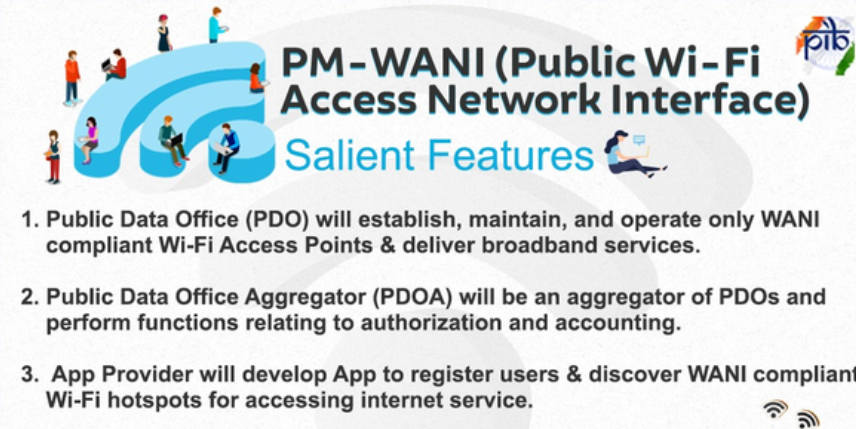
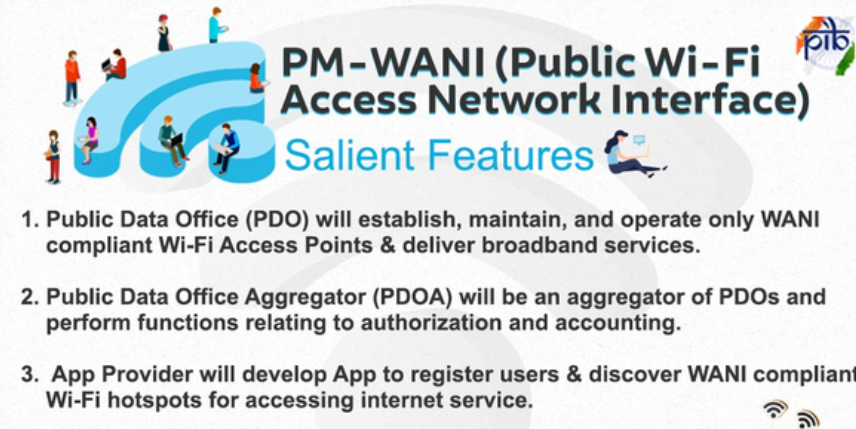
- Four-tier Architecture: The system works through four components—PDOs providing Wi-Fi, PDOAs handling authentication and accounting, App Providers enabling user access, and a Central Registry (C-DoT) that records all entities.
- FTTH Support: PDOs are now permitted to use regular fibre-to-the-home broadband connections, reducing their operational costs and making hotspot deployment more viable.
- Roaming Between PDOAs: Users can seamlessly switch between hotspots operated by different PDO Aggregators, ensuring continuous connectivity similar to mobile network roaming.
- Mobile Data Offload: PDOs can partner with telecom operators to divert mobile data traffic onto Wi-Fi networks, improving network quality and reducing mobile congestion.
- User-Based Promotions: App Providers and PDOAs may send promotional messages or content to users, but only after obtaining explicit user consent to ensure privacy protection.
- Affordable Bandwidth (TRAI Rule): TRAI requires that all retail fibre broadband plans up to 200 Mbps be sold to PDOs at no more than twice the consumer tariff, ensuring that public Wi-Fi remains affordable.
Significance:
- Bridges the digital divide by providing low-cost internet in rural and underserved regions.
- Generates local entrepreneurship, creating lakhs of micro-Wi-Fi operators.
- Enhances digital payments, e-learning, telemedicine, and e-governance reach.