




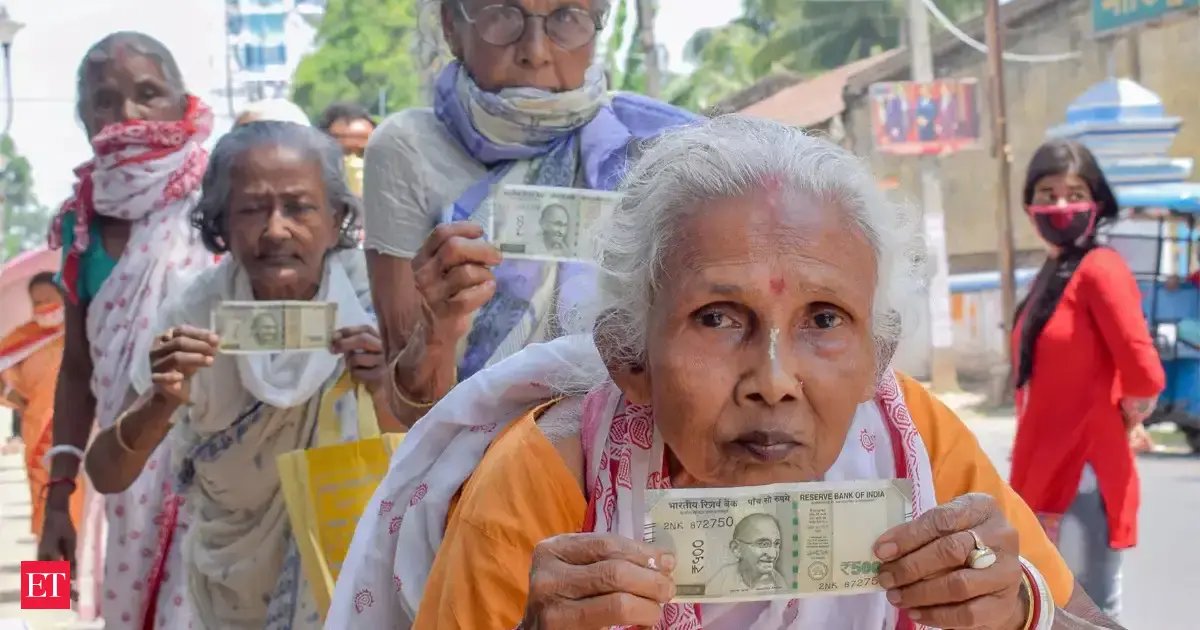
By FY26, these schemes are projected to benefit approximately 13 crore women, representing about a fifth of India’s female population, making “cash in her account” a common election promise and a substantial budget item.
This shift reflects a new approach to Indian welfare, prioritising direct money to women, often with electoral gains in mind, but also generating effects beyond votes, impacting household spending, women’s bargaining power and state finances, ToI’s report (by Richa Gandhi) said.
The funding for these cash transfers comes from state budgets, with some states allocating 2-3% of their gross state domestic product (GSDP) to women’s UCT schemes. Several states are experiencing revenue deficits, and analyses indicate their fiscal positions would appear stronger if these schemes were removed from their budgets.
The trade-off is clear: increased spending on these transfers means less funding available for other areas such as health facilities, nutrition programs and school infrastructure, unless deficits are widened. Despite this, states continue to expand these programs due to their visible, measurable and politically profitable nature.
These cash transfers are specifically designed to appeal to women voters, going beyond traditional promises of basic amenities like electricity, roads, housing and water, and are increasingly seen as catering to a new voting bloc in Indian politics.
The design of these UCT schemes varies significantly across states. Monthly payouts range from Rs 2,500 in states like Telangana, Jharkhand and Delhi to annual or one-time payments in Bihar and Andhra Pradesh. Eligibility criteria also differ widely, with some targeting married women within income limits, others including widows and single women, and a few moving towards near-universal adult coverage.This has led to a competitive dynamic among political parties and states, where a women-focused cash transfer is increasingly considered a baseline expectation regardless of which party is in power.
In Maharashtra, the allocation for the Ladki Bahin scheme alone exceeds the total welfare expenditure by over 1.5 times, a similar situation observed in Andhra Pradesh. For many states, each additional rupee directed towards UCTs places a significant burden on the budget, potentially hindering expansion of health infrastructure or nutrition programs without increasing deficits.
Nevertheless, governments appear to be signaling that providing predictable, liquid cash to women is a priority, even at the cost of other opportunities. Some states have reduced or frozen increases in other welfare items to sharply ramp up UCT allocations, effectively re-prioritising towards a flagship promise that is visible, measurable, and promises electoral benefits.
While populist cash transfer schemes can strain state balance sheets, experts argue that the fiscal burden should be considered alongside the necessity of addressing entrenched gender inequality.
Sunaina Kumar, who leads the development centre at think tank Observer Research Foundation, told ToI, “The amounts are very modest and, even then, they do make an impact on women’s rights. A large section of women is out of work and faces absolute economic marginalisation. In that context, these programmes are responding to that need. It is kind of like a short-term approach, but I think we do see positive impacts.”
The latest Household Consumption Expenditure Survey (HCES) indicates that average monthly per capita consumption expenditure (MPCE) stands at Rs 4,122 in rural India and Rs 6,996 in urban India.
For low-income households, where per capita spending might be closer to or even below these figures, a monthly transfer of Rs 1,000 to Rs 2,500 per woman is substantial. This amount can represent a significant portion of an individual’s monthly consumption.
The spending patterns observed across multiple state studies show remarkable consistency. The transferred money is generally not used for discretionary spending but rather contributes to household stability.
Food consistently ranks as the top expenditure, accounting for 53% in Maharashtra, 78% in Karnataka and 43% in Tamil Nadu. Health and medicines, along with children’s education and fees, are the next most common categories in many regions. Utilities, such as LPG, also represent a regular claim on these transfers.
A notable portion of recipients save some of the money, and some utilise it for small productive investments like livestock, farm inputs or microenterprise goods. Debt repayment is also a use for these funds, though it typically represents a smaller share of the spending.